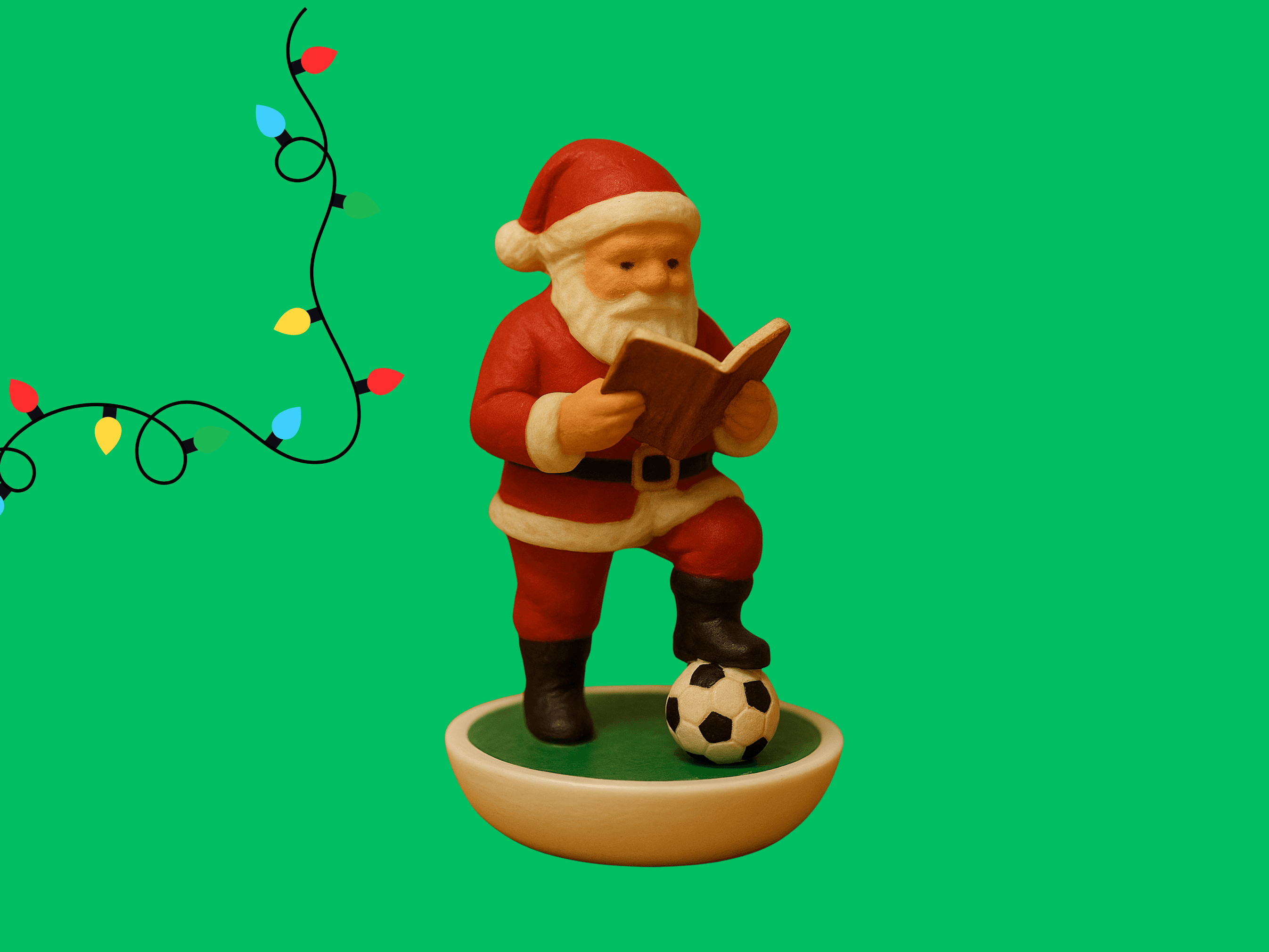
Christmas shopping tips from the Dynamo Football Bookclub
We are 50 books deep into the Dynamo Football Bookclub. We have read some brilliant books and some truly shocking ones. There are many we can recommend and others we would swot straight out of your hand if we saw you reading them in a quiet corner of a café.
We have picked up some tips which may help you if you are planning on buying a football book for a friend or family member this Christmas. Some of these rules might even apply to everything within the genre of sports books more broadly.
Beware the new book
Every Christmas, our shelves are stacked with books by recently retired players. These books should be approached with caution. Time has a way of separating the wheat from the chaff where books are concerned and if you find yourself in a shop comparing a book written 20 years ago and one released today, go for the former.
Dunphy’s first autobiography (Only a Game?) and Cascarino’s (Full Time) fall into this category and are great books. Both were formative for the genre and prove that lesser players don’t necessarily write lesser books. The two books have stood the test of time and have probably had a more lasting legacy than either of their authors’ football careers.
Dramatis personae
One of the most striking things we have learned is that some of football’s greatest characters just so happened to be some of its best players too.
In this sense, Maradona deserves special mention. Many would say that the little magician from Buenos Aires remains the sport’s greatest ever player, and after reading his autobiography (El Diego) one can’t help but conclude that he may also have been its greatest ever character. The life he led was amazing with as many surprising twists and turns as one of his mazy dribbles. It’s a great book too.
We have also read about Johan Cruyff (My Turn), Puskas (Captain of Hungary) and Gazza (Gazza in Italy) and reached similar conclusions. Is it that the fame and fortune that football skills brought these men made them interesting characters, or did it work the other way — did their characters as individuals make them good footballers? Who knows, but they were all very compelling for very different reasons, and those books are all excellent as a result.
What we do know, having recently read Van Basten’s book, is that it’s possible to have been a great player and a very dull character. His book, Basta, is to be avoided at all costs.
Dull is never good, but strange can be engaging. Michael Owen is one of football’s weirdest individuals. We decided to read his second autobiography, Reboot, precisely because he is a known odd fish. And while that book is quite tedious in parts, it does deliver insofar as giving a window into the workings of what is arguably football’s most peculiar mind of all.
Honesty and access
Autobiographies and biographies have different but related ways of being revealing.
An autobiography is generally good or bad in direct proportion to how open and honest the author is. The very reason Cascarino’s book was such a hit is that it was revealing; he included things in his book about his motivations, failings and insecurities that many before and since have chosen to omit. McGrath’s book (Back from the Brink) is worthy of mention in this sense too, although Cascarino’s is certainly a lighter read than McGrath’s.
The Garrincha biography (The Triumph and Tragedy of Brazil’s Forgotten Footballing Hero) is a very entertaining and insightful read. It’s clear that the author had access to someone very close to the player, possibly his wife, the Brazilian samba legend Elza Soares. But biographies can sometimes fail to scratch the surface. Guillem Balague’s biographies of Messi and Ronaldo are long, dull, and written from a great distance from the two towering luminaries of football’s past two decades. Avoid.
There is a particular sub-genre in autobiographies that should also be avoided: the beginner’s guide type autobiography. Crouch, Milner, and Pirlo have all written books that fall broadly within this category. They are not autobiographies as such but an introduction to the world of football, with chapters on things as illuminating as how banter on the team bus works.
The idea is enticing, especially as many autobiographies are at their most perfunctory when dealing with issues such as childhood, retirement, and so on. These books avoid the most tedious elements of life, promising instead to take us beyond the velvet rope and show us how football really works. It’s a nice idea in principle, but we haven’t read a book yet that has done it well.
A wider lens
In recent months, we have broadened our horizons to include books looking at wider football themes. The Feet of the Chameleon is an interesting book about African football, and Do You Speak Football is a fun guide to how people around the world talk about the game.
But the best book we have read so far is The Miracle of Castel di Sangro. It is a plucky book in many ways, written by an American journalist about a team you never heard of. But it has everything described above: it is honest and, in the author Jim McGinness, it has one of football literature’s greatest ever characters. And as it was written over a quarter of a century ago, it has stood — and passed — the test of time. If you are looking for a gift for a football fan, we can guarantee he/she will enjoy this one.
The Dynamo Football Bookclub is available wherever you get your podcasts.
Subscribe and join the club.